
Most families never sit down and assign roles.
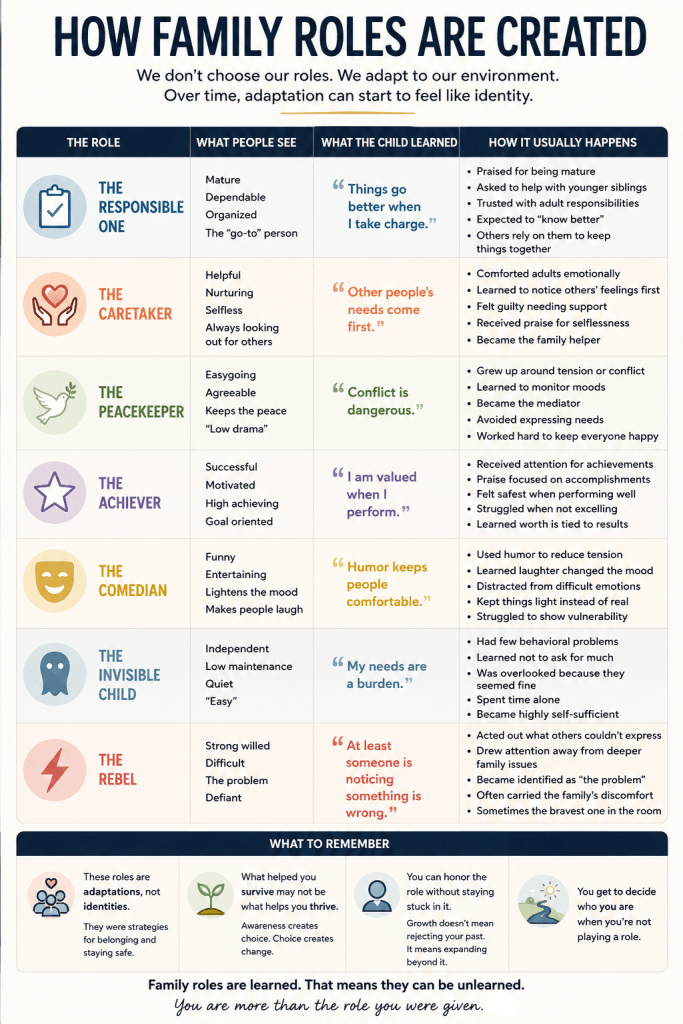
Nobody gathers everyone around the table and announces who will become the responsible one, who will keep the peace, who will take care of everyone else’s feelings, or who will become the family success story. And yet, somehow, those roles still develop. Over time, each person begins to understand what is expected of them, even if nobody ever says it directly.
If you spend enough time talking to people about their childhoods, certain patterns begin to emerge. One person was always the dependable one. Another learned not to ask for much. Someone became the helper. Someone became the achiever. Someone became the person everyone relied on when things got difficult.What is interesting is that most people do not describe these as roles. They describe them as personality.
“I’m just independent.”
“I’ve always been responsible.”
“I don’t like conflict.”
“I’ve always been the one people come to.”
Sometimes those qualities are simply personality. But often, they began as adaptations to the environment someone grew up in.
Children are remarkably observant. They pay attention to what earns approval, what creates tension, what helps them feel connected, and what keeps them safe. Over time, they repeat the behaviors that seem to work. Families, like any system, tend to reinforce behaviors that help maintain stability. The child who reduces conflict is appreciated. The child who achieves creates pride. The child who takes care of others fills a need.
Gradually, those behaviors stop feeling like strategies and start feeling like identity.
The responsible one rarely develops because someone explicitly gives them the role. More often, they become the child adults describe as mature, dependable, and easy to trust. They remember things other people forget. They notice what needs to be done and often take care of it before being asked. Over time, they learn that competence is valuable and that life tends to run more smoothly when they are paying attention.
As adults, these individuals are often highly capable. They become reliable friends, engaged partners, and dependable employees. They anticipate problems before they occur and frequently become the person everyone turns to during stressful situations. What people do not always see is the pressure that comes with that role. Many struggle to relax because they feel responsible for things that were never actually theirs to carry.
The peacekeeper learns a different lesson. In some families, conflict is loud and obvious. In others, tension exists quietly beneath the surface. Either way, some children become highly skilled at reading emotional environments. They learn to notice shifts in mood, avoid topics that create conflict, and adjust their behavior to keep interactions running smoothly.
As adults, peacekeepers are often described as thoughtful, emotionally aware, and easy to get along with. They can usually see multiple perspectives and often help others feel understood. The challenge is that they sometimes become so focused on maintaining harmony that they lose touch with their own preferences. They may avoid difficult conversations, minimize their own frustrations, or feel guilty when their needs create discomfort for someone else.
The caretaker develops when a child becomes highly attuned to other people’s needs. This can happen for many reasons. A parent may be overwhelmed. A sibling may require extra attention. Helping may simply become one of the easiest ways to feel useful, appreciated, or connected. Whatever the reason, the child learns that paying attention to others matters.
These children often become adults who are exceptionally skilled at supporting people. They know when something is wrong before anyone says a word. They check in, offer help, and show up when people need them. The difficulty is that many caretakers become so accustomed to giving support that receiving it feels uncomfortable. They know how to care for everyone else but often struggle to identify or advocate for their own needs.
The achiever receives a different type of reinforcement. Achievement gets noticed. Good grades, accomplishments, awards, and success tend to generate attention and praise. There is nothing inherently wrong with that. The problem develops when achievement becomes closely tied to a person’s sense of value.
Many achievers grow into highly motivated and successful adults. They set goals, work hard, and accomplish impressive things. Yet many also describe feeling as though the goalposts are constantly moving. Success provides satisfaction, but only briefly. Before long, attention shifts to the next goal, the next accomplishment, or the next thing that needs to be proven.
What makes family roles difficult to recognize is that most people are not carrying just one.
The responsible one is often also the caretaker. The achiever may also be the peacekeeper. The child who learned not to cause problems may have become fiercely independent while quietly managing everyone else’s emotions. Real families are complicated, and children rarely adapt in only one way.
A child may learn that they need to excel academically, avoid conflict at home, and help care for younger siblings. Years later, that same person may be successful, dependable, empathetic, and completely exhausted without fully understanding why. This is often the moment people begin recognizing themselves. Not because they suddenly understand their family perfectly, but because they begin to understand the patterns they have been carrying for years.
They start to see why asking for help feels uncomfortable. Why saying no feels selfish. Why conflict feels bigger than it should. Why rest feels unproductive. Why they feel responsible for fixing problems they did not create.
The goal is not to blame our families or reduce every personality trait to childhood. The goal is understanding. Many of the behaviors people criticize in themselves once served an important purpose. They helped them belong. They helped them stay connected. They helped them navigate circumstances they did not choose.
One of the challenges with family roles is that they often produce qualities people genuinely value. The responsible child may become a strong leader. The caretaker may become deeply empathetic. The achiever may build a meaningful career. The peacekeeper may develop strong emotional awareness. These qualities are not problems in themselves.
The problem begins when those qualities stop feeling like choices. Responsibility becomes obligation. Caring becomes self-sacrifice. Achievement becomes self-worth. Peacekeeping becomes self-silencing. Somewhere along the way, a strategy became an expectation, and a role began to feel like an identity.
One of the more freeing realizations of adulthood is that we can keep the strengths without keeping the role. We can be responsible without carrying everything. We can care about people without becoming responsible for them. We can pursue success without constantly proving our worth. We can tolerate conflict without believing the relationship is in danger.
Family roles are adaptations. They are not identities.
They may explain some of what we carry, but they do not have to define the rest of our lives. Adulthood gives us something childhood rarely could: the opportunity to decide which parts of the role still belong to us and which parts no longer do.
 Amanda Brindle, LCSW