

Most of us can remember a conversation that stayed with us long after it ended.
Sometimes it’s because we walked away feeling lighter. We finally said the thing we’d been carrying around, and whether the other person agreed or not, we left feeling understood. Other times, we replay the conversation for hours. We think of everything we should have said differently. We wonder if we shared too much, if we were too emotional, or if we should have kept it to ourselves altogether.
The topic of the conversation often isn’t what determines which feeling lingers.
It’s how we were received.
Every meaningful relationship is built on thousands of small moments where people decide whether it’s safe to keep showing up honestly. That decision isn’t usually conscious. It happens quietly, over time, as we learn what happens when we admit we’re struggling, ask a difficult question, make a mistake, or express an opinion someone else may not share.
Those moments teach us whether we’re being heard or being judged.
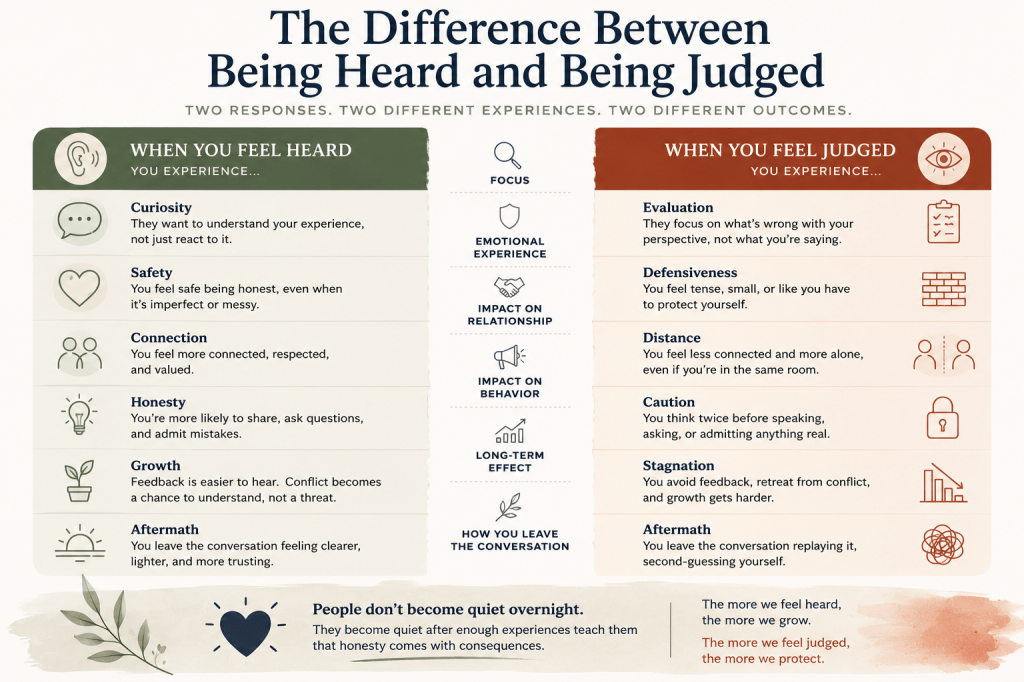
Being heard doesn’t mean someone agrees with you. It doesn’t mean they immediately apologize, change their behavior, or tell you you’re right. In fact, some of the most productive conversations involve disagreement. The difference is that when we feel heard, we believe the other person is trying to understand our perspective before evaluating it.
You can usually recognize it in small ways. Someone asks another question instead of jumping to a conclusion. They stay curious instead of becoming defensive. They don’t rush to solve the problem before they’ve understood it. They allow room for your experience to exist, even if theirs is different.
When people consistently experience that kind of response, something begins to change.
They become more honest because they don’t have to spend energy protecting themselves. They admit mistakes sooner because they trust the mistake won’t define them. They ask more questions because they don’t fear looking incompetent. They become more willing to disagree because disagreement doesn’t threaten the relationship.
Ironically, feeling heard often makes people more open to feedback. When someone believes they’re understood, they become far less invested in defending themselves. They’re able to listen because they no longer feel like they’re fighting to prove their experience mattered in the first place.
Judgment creates the opposite pattern.
Judgment doesn’t always sound harsh. Sometimes it arrives as advice that comes too quickly. Sometimes it’s minimizing someone’s experience, questioning their intentions, or deciding whether their feelings are reasonable before trying to understand them. Sometimes it’s subtle enough that neither person recognizes it’s happening.
Over time, though, the impact is remarkably consistent.
People begin editing themselves. They rehearse conversations before they happen. They overexplain simple decisions. They soften opinions with phrases like, “This might sound stupid…” or “Maybe I’m overreacting…” They decide certain topics aren’t worth bringing up because they already know how the conversation is likely to end.
Eventually, silence starts feeling safer than honesty.
This is why the same person can appear completely different depending on who they’re’re with.
Someone who barely contributes during one meeting becomes thoughtful and engaged in another. A teenager who gives one-word answers at home talks nonstop with a trusted coach. A partner who seems emotionally distant in one relationship becomes expressive in another. We often assume confidence is a personality trait, but confidence is also shaped by environment. People tend to reveal more of themselves where they expect understanding instead of evaluation.
Psychologists often describe this as psychological safety, but most of us don’t use that phrase in everyday life. We simply know which people feel easy to talk to. We know who lets us ask questions without making us feel foolish. We know who can challenge our thinking without making us feel small. We know who can disagree with us while still communicating respect.
We also know the opposite.
We know the people around whom we carefully rehearse what we’re going to say. The people whose reactions we predict before bringing up a concern. The people who unintentionally teach us that being honest requires being ready to defend ourselves.
What’s easy to miss is that neither pattern develops overnight.
A child doesn’t become quiet because of one conversation. An employee doesn’t stop sharing ideas after one meeting. A partner doesn’t stop bringing up concerns after one disagreement. These patterns emerge through repetition. Every interaction adds another piece of evidence about what honesty costs and what honesty earns.
That’s why the difference between being heard and being judged reaches far beyond communication. It shapes trust.
When people feel heard, trust grows. They become more willing to repair after conflict, to admit uncertainty, to ask for help, and to believe the relationship can withstand difficult conversations. Honesty becomes easier because the relationship has proven it can hold it.
When people feel judged, self-protection grows instead. Conversations become shorter. Questions go unasked. Mistakes stay hidden. Disagreements become quieter, not because they’ve disappeared, but because they’ve moved inward. The relationship may look peaceful on the surface while becoming increasingly disconnected underneath.
Whether we’re parents, partners, friends, leaders, coworkers, or clinicians, we all influence which pattern takes root in the people around us. Not because we’re responsible for someone else’s history, but because every conversation communicates something about what happens when another person tells us the truth.
Being heard isn’t about agreement.
Being judged isn’t always about criticism.
More often, the difference comes down to a simple question that every interaction answers, whether we realize it or not:
When I bring you something real, will you try to understand me before you decide what you think of me?

