
You notice your partner is quieter than usual, and before long you’re wondering if you did something wrong.
Your boss sends a short email, and suddenly you’re replaying yesterday’s meeting.
Your friend doesn’t text back, and you’re debating whether you should send another message or just leave it alone.
Your parent seems stressed, and you spend the rest of the conversation trying to make them feel better instead of noticing how you’re feeling.
None of these situations necessarily have anything to do with you. But somehow, they become your problem to solve.
I’ve found that many people who struggle with this aren’t simply anxious. They’re incredibly caring people who have gradually learned to feel responsible for everyone else’s emotional experience. They aren’t just aware of other people’s feelings. They’re constantly monitoring them, trying to figure out what they need to do to make everything okay again. If someone they love is hurting, disappointed, frustrated, or distant, their own nervous system struggles to settle until the situation feels resolved.
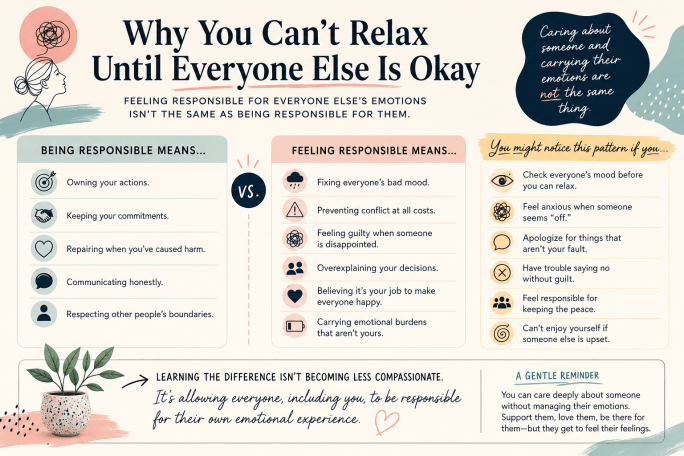
The important distinction is that caring and feeling responsible aren’t the same thing.
Caring says, “I don’t like seeing someone I love hurting.”
Feeling responsible says, “It’s my job to make sure they stop hurting.”
At first, those ideas can feel almost identical. In fact, that’s exactly how this pattern develops. Most people don’t wake up one day deciding they’re responsible for everyone else’s emotions. It usually starts with empathy. You care about someone, you naturally want to help, and helping often strengthens the relationship. The problem is that over time, your brain can start connecting someone else’s emotional state with your own sense of safety. If they’re okay, you can finally relax. If they aren’t, you stay emotionally on call.
The more you care about someone, the easier it becomes to confuse caring for them with carrying them.
Sometimes that pattern starts in childhood. Maybe you grew up in a home where emotions were unpredictable, so you learned to pay attention to everyone else’s mood before you paid attention to your own. Maybe you became the peacemaker, the mature one, or the child who never wanted to make things harder for anyone else. When your environment teaches you that keeping other people emotionally regulated helps maintain connection or avoid conflict, your brain learns that paying attention to everyone else is important.
But childhood isn’t the only place these patterns develop.
I’ve seen this happen in marriages where one partner slowly becomes responsible for every repair after an argument. In friendships where one person always checks in first, smooths things over, or worries they’re asking for too much. In families where someone becomes the emotional caretaker for their parents or siblings. Even workplaces can reinforce it, especially if you’re constantly trying to anticipate other people’s reactions or keep everyone happy.
Our brains are always learning. If taking responsibility for someone else’s emotions seems to reduce conflict, preserve a relationship, or make life feel more predictable, we’ll keep doing it. Not because it’s healthy, but because it worked well enough to become a habit.
Eventually, the habit becomes so automatic that you stop noticing it.
You apologize before expressing a need because you don’t want anyone to feel uncomfortable.
You explain your decisions in exhausting detail because you’re trying to prevent someone from being disappointed.
You replay conversations, wondering whether you could have worded something differently.
You struggle to say no because someone else’s disappointment feels heavier than your own exhaustion.
You spend so much time checking whether everyone else is okay that you rarely stop to ask yourself the same question.
One of the things I notice most often in therapy is that these clients don’t struggle because they refuse to take responsibility. They struggle because they’re carrying far more responsibility than actually belongs to them.
They believe the relationship depends on them communicating perfectly. They assume that if someone is upset, they need to fix it. They become the one initiating every repair, smoothing over every disagreement, checking in after every conflict, and trying to make sure everyone feels okay before they allow themselves to relax.
Over time, they stop noticing where their responsibility ends and someone else’s begins.
Healthy relationships don’t work that way.
Every healthy relationship requires us to take responsibility for ourselves. That means owning our behavior, communicating honestly, apologizing when we’ve caused harm, and making repairs when they’re ours to make. It does not mean managing another person’s emotional world. We can influence each other, support each other, and care deeply about each other, but we cannot take ownership of emotions that don’t belong to us.
When one person quietly becomes responsible for maintaining the emotional health of the relationship, they end up carrying work that was never meant to be done by one person alone.
That’s why this pattern is so exhausting.
Your peace becomes dependent on something you can’t control.
You can’t fully relax because you’re constantly scanning the people around you. Is my partner okay? Is my friend upset? Did I offend someone? Is there another conversation I need to have? Is everyone okay?
The answer to those questions begins determining whether you feel okay.
Healing isn’t about becoming less caring. It isn’t about setting harsh boundaries or deciding that other people’s feelings don’t matter. It’s about recognizing that empathy and responsibility are not the same thing.
You can care deeply about someone without fixing their emotions.
You can support someone without carrying their distress.
You can love someone without making their happiness your job.
The next time you notice yourself unable to relax because someone else seems upset, pause for a moment and ask yourself one question:
Am I responsible for this, or do I just feel responsible for it?
That question won’t change years of learned patterns overnight.
But it might help you notice something important: caring for someone and carrying them have never been the same thing.
The healthiest relationships aren’t built on one person managing everyone else’s emotional experience. They’re built on two people each taking responsibility for their own.