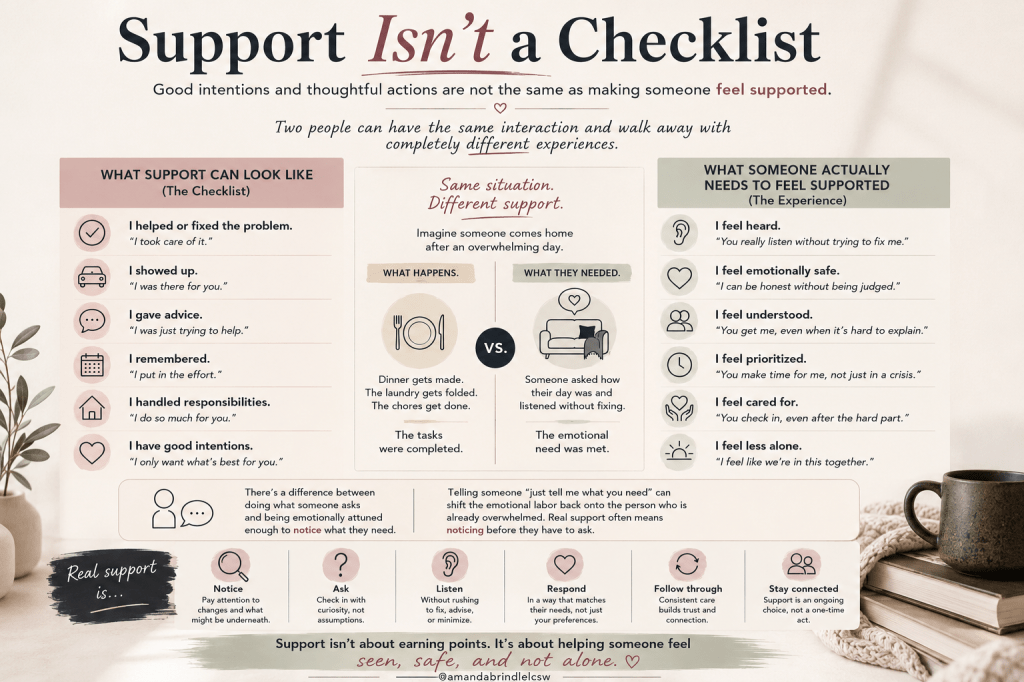

When people describe a supportive partner, friend, or family member, they often start listing what that person does.
They show up. They help around the house. They remember birthdays. They drive you to appointments. They offer advice. They make dinner. They take care of the kids. They handle the bills. They ask, “What do you need?”
Those things matter. They are acts of care, generosity, and love.
But they’re not the same thing as feeling supported.
One of the easiest ways for two people to become disconnected is to assume they’re using the same definition of support. One person is thinking, “Look at everything I do for you.” The other is thinking, “I know you do a lot, but I still feel alone.” Both people can leave the conversation feeling misunderstood because they’re measuring support in completely different ways. One is measuring effort. The other is describing an emotional experience.
I was reminded of this while watching a reunion show recently. One person explained that they felt more supported in a newer relationship. Another immediately responded by listing all the things they had done over the years: making the bed, doing taxes, handling responsibilities, taking things off their partner’s plate. As I watched the conversation unfold, it became clear they weren’t disagreeing about whether effort existed. They were disagreeing about what support actually means.
For many people, support becomes a checklist. Did I help? Did I fix the problem? Did I do what you asked? If the answer is yes, it’s confusing when the other person still says they don’t feel supported. That confusion often turns into defensiveness because it feels like all of the effort is being dismissed.
The other person usually isn’t saying those things don’t matter. They’re saying something different is missing.
Imagine someone comes home after an overwhelming day at work. Their partner immediately starts making dinner, folds the laundry, or takes care of the evening responsibilities. Those are thoughtful things to do, and for many people, they would absolutely feel supportive.
Now imagine someone else comes home after the same kind of day. Their partner notices they seem quieter than usual, puts their phone down, asks what happened, listens without interrupting, and says, “That sounds really hard.” Maybe they ask, “Do you want to talk about it, or would you rather just sit together for a while?” Nothing practical has been crossed off the to-do list, but that person walks away feeling understood and less alone.
Neither response is inherently better. In healthy relationships, both matter. We all need practical support at times, and we all need emotional support. The problem is that many people naturally offer the kind of support they would want to receive instead of paying attention to what the other person needs in that moment.
This is where another misunderstanding often develops. Someone says, “Just tell me what you need.”
On the surface, that sounds supportive. Healthy relationships absolutely require communication, and none of us can be expected to read someone else’s mind.
But there is an important difference between being willing to help after someone tells you exactly what they need and being emotionally attuned enough to notice they need support before they have to ask.
When someone is already overwhelmed, asking them to identify what they need, explain it, delegate it, remind you, and then thank you for doing it can become one more thing they’re responsible for managing. The original problem hasn’t just become their burden. Now the responsibility of coordinating their own support has been added to it.
That doesn’t mean we should expect people to anticipate every need perfectly. That’s unrealistic and unfair. It does mean that healthy relationships involve more than waiting for instructions. They involve paying attention. They involve noticing when your partner seems different, asking questions instead of assuming they’re fine, and taking initiative when it’s appropriate. Sometimes the most supportive thing you can say isn’t, “Tell me what you need.” It’s, “You seem overwhelmed. I’ve already started dinner. Do you want to talk, or would some quiet feel better right now?”
Support isn’t just about responding. It’s about noticing.
I also think this is why so many people begin questioning themselves when something feels off in their relationship. They look at everything their partner, friend, or family member does and think, They’re helping around the house. They never miss an event. They always say they’d do anything for me. Why do I still feel unsupported? Instead of wondering whether an emotional need is going unmet, they often conclude that they’re expecting too much or that they should simply be more appreciative.
Sometimes the boxes really are being checked.
The chores get done.
The bills get paid.
The responsibilities are shared.
Those things matter, and many relationships struggle because they aren’t happening.
But checking every box doesn’t automatically create emotional connection. A relationship can function efficiently while one or both people still feel emotionally alone.
The healthiest relationships don’t just ask, “What needs to get done?” They also ask, “What does this person need from me right now?” Sometimes the answer is practical help. Sometimes it’s reassurance. Sometimes it’s quiet company. Sometimes it’s encouragement. Sometimes it’s simply feeling like someone noticed they were struggling without needing to be convinced first.
Support isn’t measured by how many things you do for someone.
It’s measured by whether your presence helps them feel less alone.
That doesn’t happen because you completed a checklist.
It happens because the person you love experiences you as someone who sees them, understands them, and is willing to meet them where they are—not just where it’s easiest for you to help.